
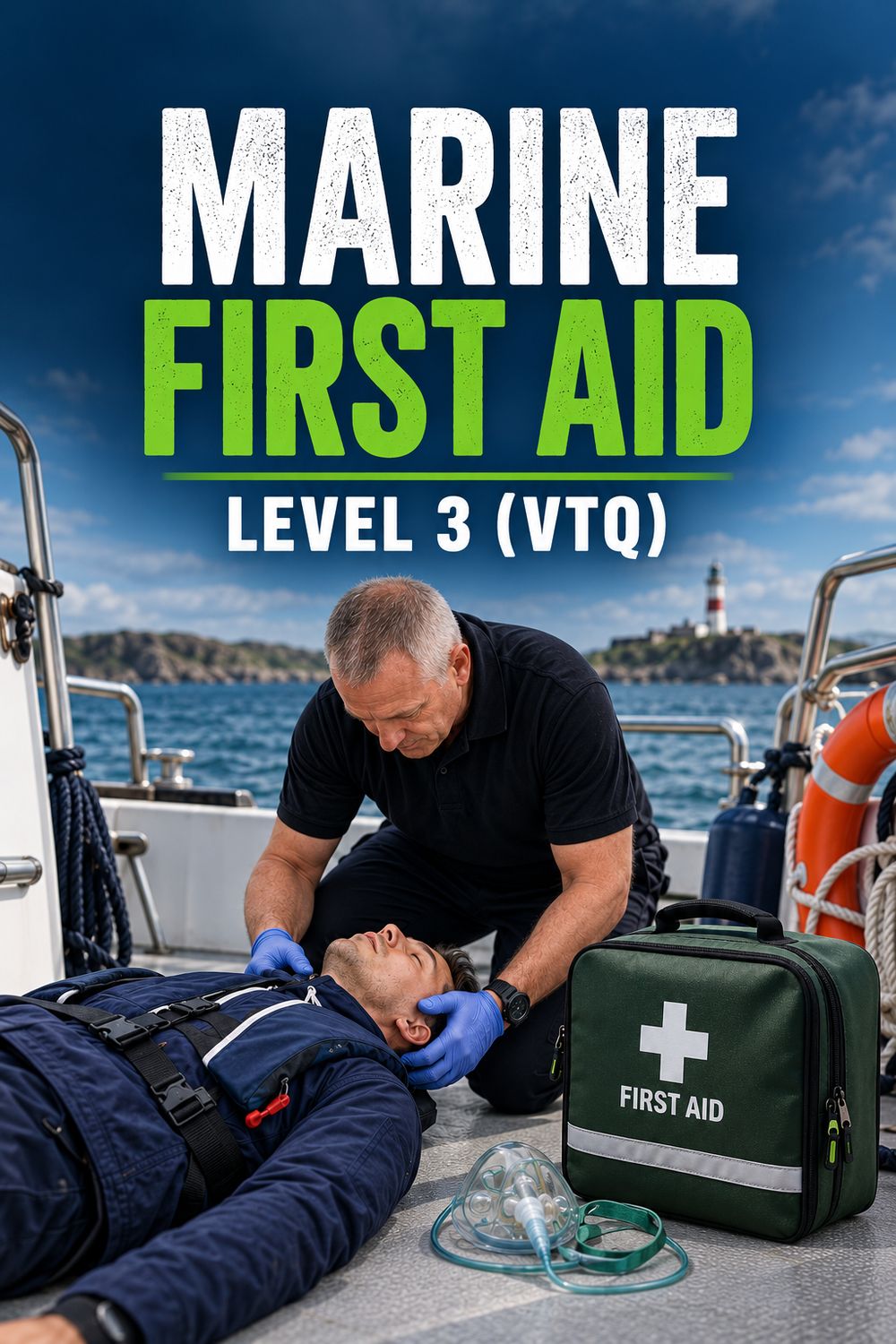
Marine First Aid Level 3 (VTQ)
Marine First Aid Level 3 (VTQ) – 6 Hour Course
Practical first aid training for boating, marine and watersports environments where professional medical assistance may be delayed.
Our Marine First Aid Level 3 (VTQ) course is a practical, instructor-led 6-hour first aid course designed for people who work, travel or participate in activities on or around the water.
Marine emergencies present particular challenges. Professional medical assistance may be some distance away, communications can be difficult, casualties may need to be managed for longer periods, and treatment may have to take place in confined, exposed or moving environments.
This course develops the knowledge, practical skills and confidence needed to assess and manage injuries and medical emergencies in a marine environment until professional assistance is available.
Training is delivered in accordance with the Resuscitation Council UK (RCUK) 2025 Guidelines and current UK first aid guidance, with an emphasis on practical competence and effective emergency response.
Who should attend?
Marine First Aid Level 3 is particularly suitable for:
- Boat owners and recreational sailors
- Skippers and crew
- Marine and maritime personnel
- Sailing and boating instructors
- Watersports and outdoor activity instructors
- Yacht and powerboat users
- Marine leisure staff
- People responsible for safety during activities on or around the water
It is also suitable for anyone who wants first aid training that considers the particular challenges associated with remote and marine environments.
What does the course cover?
The course covers essential first aid skills together with their application in marine and boating environments, including:
- Role and responsibilities of the first aider
- Assessing an emergency safely
- Primary and secondary casualty assessment
- Cardiopulmonary Resuscitation (CPR)
- Practical use of an Automated External Defibrillator (AED)
- Management of an unresponsive casualty
- Recovery position and ongoing monitoring
- Choking
- Seizures
- External and life-threatening bleeding
- Wound management
- Tourniquets and haemorrhage control
- Recognition and management of shock
- Fractures, dislocations, sprains and strains
- Head injuries and concussion
- Suspected spinal injuries
- Chest injuries
- Burns and scalds
- Heart attack and stroke
- Asthma and diabetic emergencies
- Anaphylaxis and severe allergic reactions
- Hypothermia and the effects of cold exposure
- Drowning and post-rescue casualty care
- Managing a casualty where access to professional medical assistance may be delayed
First aid in the marine environment
The course considers how standard first aid principles need to be applied when an emergency occurs on a boat, around water or in a remote marine environment.
This includes consideration of:
- Delayed access to emergency medical services
- Summoning assistance and communicating with emergency services
- Cold and wet environments
- Hypothermia and exposure
- Drowning and water-related emergencies
- Limited space and restricted access to casualties
- Vessel movement and environmental conditions
- Available first aid equipment
- Ongoing casualty monitoring while awaiting assistance
- Evacuation and transfer of casualties to professional care
Practical exercises can be adapted to reflect the types of incidents learners may realistically encounter within their own boating, marine or watersports activities.
Course duration
6 hours of instructor-led training, excluding breaks.
The course is normally delivered as a full day of practical classroom training.
Assessment
Learners are assessed throughout the course through continuous practical observation and knowledge assessment.
The course has a strong practical emphasis, with learners given the opportunity to practise essential first aid skills and apply them to realistic marine emergency scenarios.
Course delivery
This specialist course is usually delivered on demand at our clients' premises or an appropriate marine or watersports training location.
By prior arrangement, the course can also be delivered at our training venue for a client group, subject to venue availability.
Client-site delivery can be particularly valuable for marine organisations, sailing clubs and watersports providers because scenarios can be considered within the context of their own activities, equipment and emergency arrangements.
Certification
Learners who successfully complete the course and assessment receive a ProTrainings Marine First Aid Level 3 (VTQ) certificate.
Annual first aid skills and knowledge refreshers are recommended to help maintain practical competence and confidence.
Important – Marine First Aid and RYA requirements
If you require first aid certification for a specific professional, commercial or governing-body requirement, please check the certification required before booking.
Vital Signs Scotland also provides RYA First Aid training for individuals who specifically require an RYA-recognised First Aid certificate.
Why is marine first aid different?
An emergency at sea or on inland water can be very different from the same emergency on land.
A first aider may need to manage a casualty for an extended period while dealing with distance from professional medical care, cold, wet conditions, restricted space, vessel movement and limited equipment.
Effective marine first aid training therefore develops not only first aid skills, but the ability to assess, stabilise, monitor and care for a casualty until further medical assistance or evacuation can be arranged.
Any questions?
If you are unsure whether Marine First Aid Level 3 (VTQ), RYA First Aid or another first aid qualification is most appropriate for your boating or marine activities, please contact us. We will be happy to discuss your requirements.
Telephone:
01506 333310
Email:
info@vitalsignsscotland.co.uk