
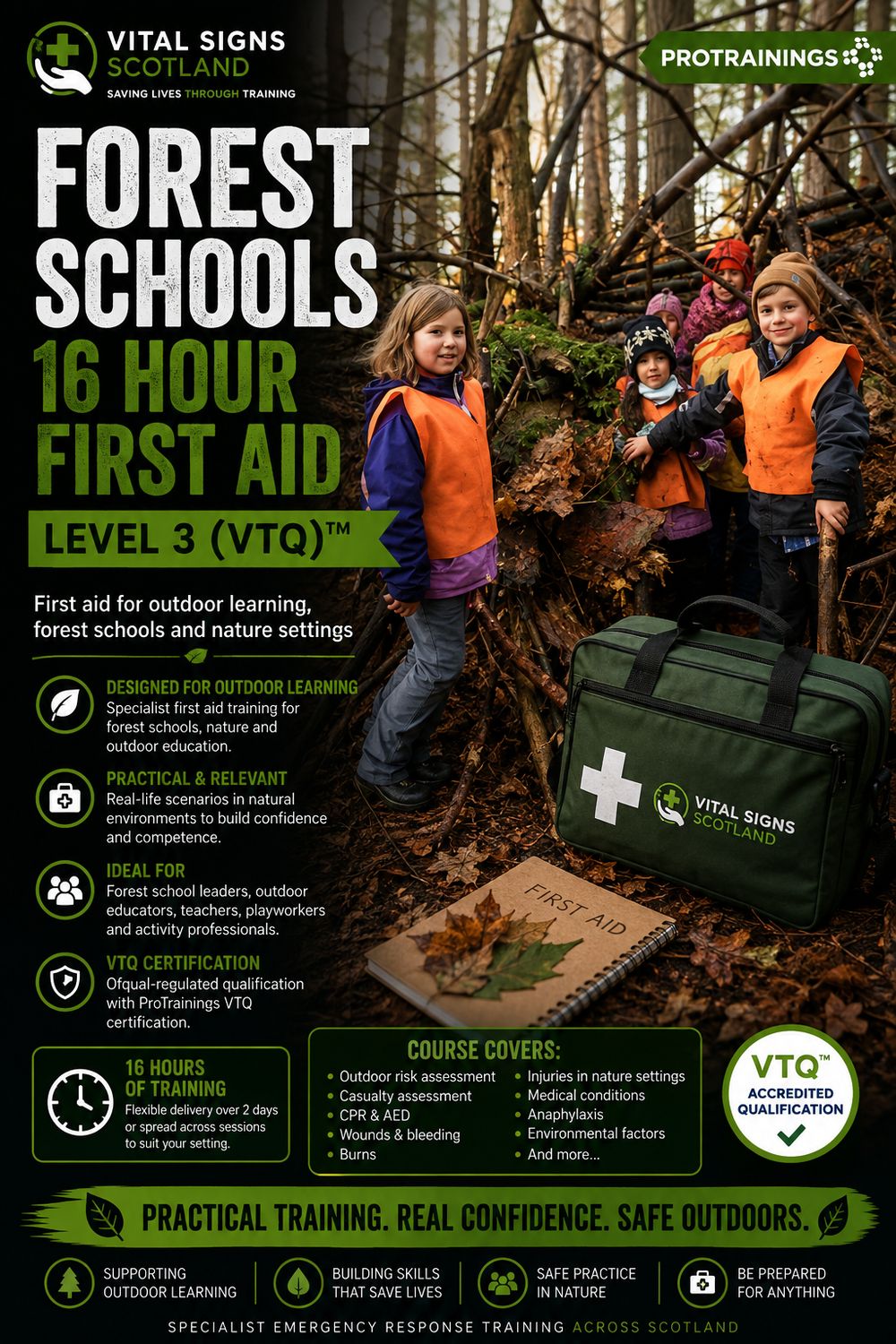
Forest Schools 16 Hour First Aid Level 3 (VTQ)
2-Day Practical Classroom Course
The Forest Schools 16 Hour First Aid Level 3 (VTQ)™ is a comprehensive two-day first aid course specifically designed for Forest School practitioners and those working with children and adults in outdoor learning environments.
Working in woodland and other outdoor settings presents challenges that are not always encountered in conventional workplace first aid. Casualties may be exposed to the elements, emergency assistance may take longer to arrive, and incidents can involve both adult and paediatric casualties.
This course develops the knowledge, practical skills and confidence required to respond effectively to a wide range of emergencies in a Forest School, woodland or outdoor learning environment.
Who Is This Course Suitable For?
The course is particularly suitable for:
- Forest School leaders and practitioners
- Outdoor educators
- Teachers and teaching assistants involved in Forest School activities
- Early years and childcare practitioners
- Playworkers
- Outdoor learning staff
- Activity leaders
- Organisations delivering woodland and nature-based learning
Managing Emergencies in Outdoor Settings
Learners develop a structured approach to managing an emergency in an outdoor environment, including:
- The role and responsibilities of the Forest School first aider
- Infection prevention and personal safety
- Consent and first aid
- Scene assessment and incident management
- Adult and paediatric primary surveys
- Summoning appropriate emergency assistance
- Protecting casualties from environmental factors
- Managing casualties at risk of hypothermia
The course recognises that providing first aid outdoors can be very different from responding within a conventional workplace or classroom.
CPR, AED & Life-Threatening Emergencies
Practical training covers the assessment and management of unresponsive casualties, including both adult and paediatric emergencies.
Learners cover:
- Adult, child and infant casualty assessment
- Recovery positions
- Seizures
- Adult CPR
- Paediatric CPR
- Automated External Defibrillator (AED) use
- Adult, child and infant choking
The course also considers modifications to CPR where incidents involve drowning, avalanche, lightning strike or situations remote from immediate help.
Injuries, Bleeding & Trauma
Forest School environments can involve tools, uneven ground, trees, natural obstacles and physical activity. The course therefore includes the recognition and management of a wide range of injuries.
Training includes:
- Minor wounds
- Severe external bleeding
- Shock
- Burns and scalds
- Fractures
- Dislocations
- Sprains and strains
- Head, neck and back injuries
- Major injury recognition
- Practical log-roll techniques
- Eye, ear and nose injuries and foreign bodies
Learners also develop skills in obtaining a casualty history and carrying out a secondary head-to-toe survey.
Medical Emergencies
The course covers the recognition and initial management of important medical conditions that could occur during Forest School and outdoor activities, including:
- Allergic reactions
- Anaphylaxis
- Asthma
- Diabetic emergencies
- Febrile convulsions
- Heart attack
- Stroke
- Meningitis
Training includes recognising the signs and symptoms of these conditions and understanding the appropriate first aid response.
Environmental & Outdoor Emergencies
Particular attention is given to emergencies relevant to outdoor environments, including:
- Hypothermia and cold-related illness
- Heat-related illness
- Water immersion
- Drowning-related emergencies
- Electrical incidents and electric shock
- Poisoning
- Environmental exposure
This helps learners consider not only the casualty's immediate injury or illness, but also the effect that the surrounding environment and potentially delayed access to emergency assistance can have on casualty management.
Practical, Scenario-Based Training
The 16-hour programme combines underpinning knowledge with practical skills and scenarios relevant to Forest School environments.
Learners practise essential techniques including CPR, AED use, casualty assessment, bleeding control, recovery positions and casualty handling, helping develop the confidence to apply first aid skills when faced with an emergency outdoors.
Course Duration & Certification
Duration: 16 hours over 2 classroom days
Qualification: Forest Schools 16 Hour First Aid Level 3 (VTQ)™
Course Type: Practical classroom training
Certification: ProTrainings Level 3 (VTQ) certification
The course content has been independently certified as conforming to recognised Continuing Professional Development (CPD) guidelines and includes a Certified CPD Statement alongside the ProTrainings certificate.
An endorsed TQUK certificate may also be requested for an additional charge. The training course content remains the same whichever certification option is selected.
Forest School First Aid Training in Scotland
Delivered by Vital Signs Scotland, the Forest Schools 16 Hour First Aid Level 3 (VTQ)™ provides specialist first aid training for those responsible for children, young people and adults in woodland, Forest School and outdoor learning environments.
The combination of adult and paediatric first aid, outdoor incident management, environmental emergencies and practical scenario-based training makes this particularly relevant to organisations where activities take place away from a conventional indoor setting.
Group and in-house Forest School First Aid training is available across Scotland for schools, nurseries, Forest School providers, outdoor learning organisations and other groups requiring specialist outdoor first aid training.
Saving Lives Through Training | Emergency Preparedness Specialists